

Crane Boom Angle, Radius and Tip Height
Working radius sets how much a crane can lift; tip height sets what it can reach over. Both come from the same two numbers — boom length and boom angle — plus where the boom pivot sits on the crane. The geometry is simple trigonometry. The part that catches people out is that the radius on the drawing is not the radius under load.
Updated 28 October 2026
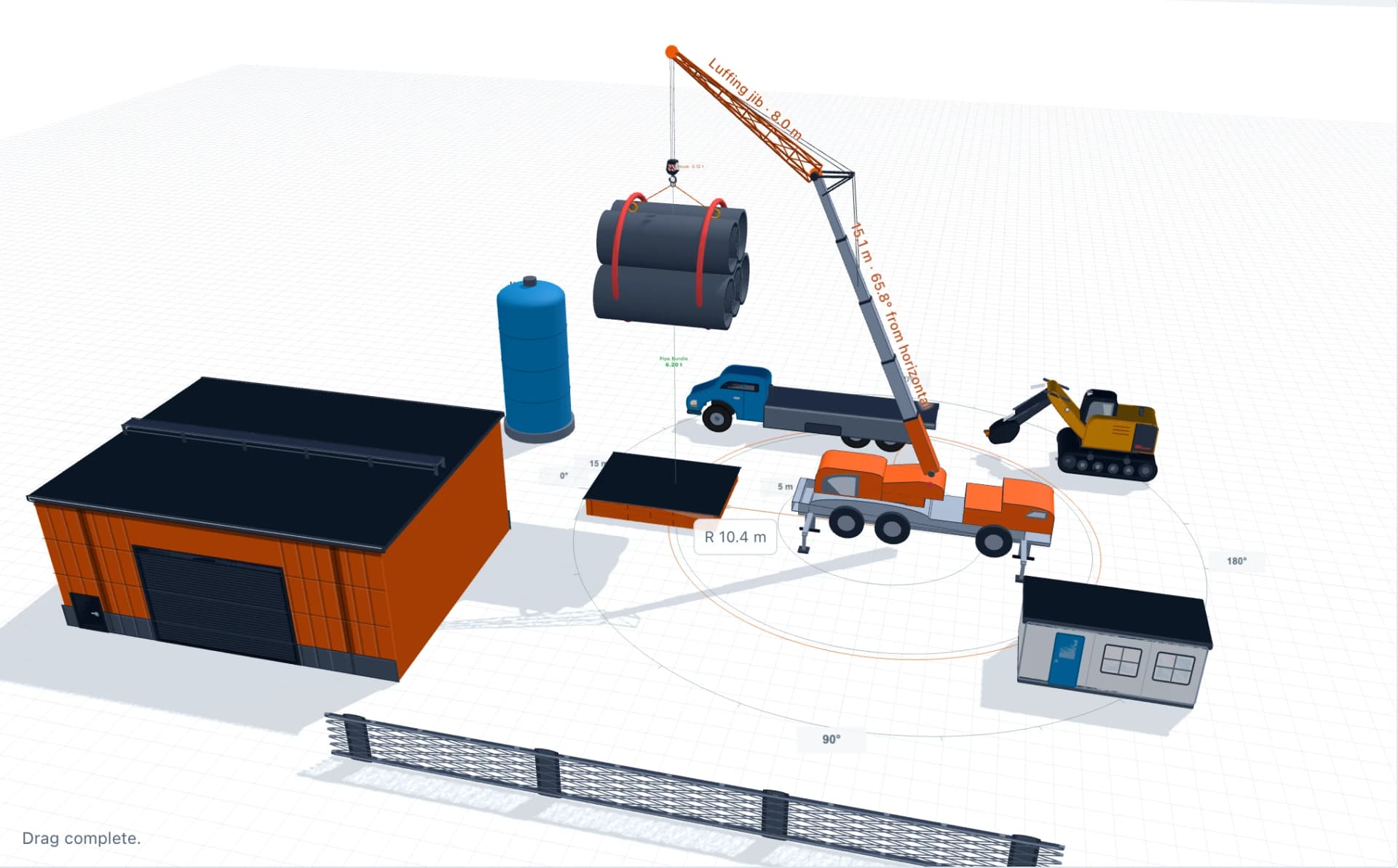
See the whole lift in 3D Top View.
Check the crane, load and site obstacles together before the crane arrives, alongside the range chart and lift plan.
See 3D Top ViewWhat working radius means
Working radius is the horizontal distance from the crane’s centre of rotation to the centre of the hoist line with the load hanging. It is measured from the centre of rotation — not from the front of the crane or the outriggers — and it is the value you read against on the load chart.
The formulas
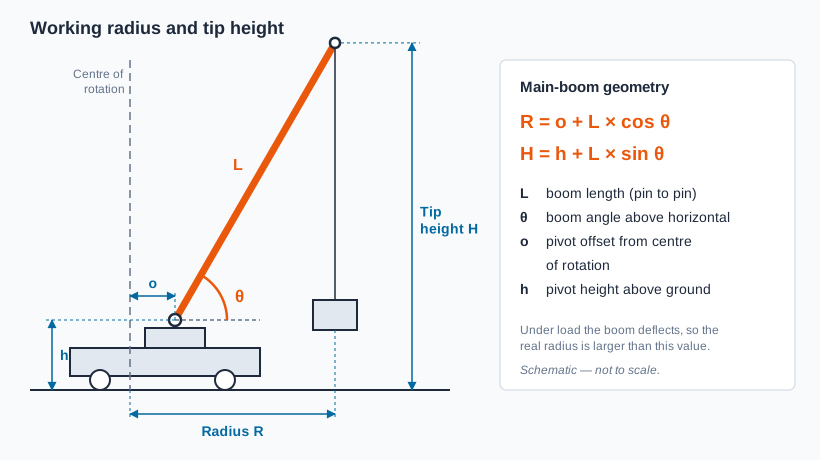
Radius = Pivot offset + Boom length × cos θTip height = Pivot height + Boom length × sin θθ is the boom angle above horizontal and boom length is pin to pin. If the boom pivot sits behind the centre of rotation, subtract the offset instead of adding it.
Worked example
Illustrative numbers: a 50 m boom at 60°, with the pivot 2.5 m above the ground and 1.5 m in front of the centre of rotation.
- Radius — 1.5 + 50 × cos 60° = 1.5 + 25.0 = 26.5 m.
- Tip height — 2.5 + 50 × sin 60° = 2.5 + 43.3 = 45.8 m.
- Working back from radius — To reach a 26.5 m radius with the same boom, the angle is cos⁻¹((26.5 − 1.5) ÷ 50) = 60.0°.
| Boom angle | Working radius | Tip height |
|---|---|---|
| 30° | 44.80 m | 27.50 m |
| 45° | 36.86 m | 37.86 m |
| 55° | 30.18 m | 43.46 m |
| 60° | 26.50 m | 45.80 m |
| 70° | 18.60 m | 49.48 m |
| 80° | 10.18 m | 51.74 m |
Lowering this boom from 60° to 55° moves the load out 3.7 m. On a long boom, small angle changes make large radius changes, which is why the radius has to be checked rather than assumed.
Why the real radius is larger
The formulas give the geometric radius of an unloaded, perfectly straight boom. Under load a boom deflects — telescopic booms in particular — and the hoist line moves further out. Out-of-level ground can add more when the crane slews towards the low side. The load chart is read at the actual radius with the load hanging, so the geometric value is a starting point, not the final number.
- Measure the radius on site from the centre of rotation, or use the crane’s radius display as described in its operator manual.
- Check capacity at the largest radius the load will reach, including where it is set down.
- Where the manufacturer provides boom deflection information, use it.
Tip height is not hook height
Tip height is the height of the boom head. The hook sits below it by the hoist rope, the hook block and the rigging, and the load hangs below that. To check headroom, work down from the tip: subtract the hook block, the rigging and the load height, and keep the minimum clearance between hook block and boom head that the manufacturer specifies to avoid two-blocking.
Jibs
A jib adds length at the boom head, usually offset downward from the boom line. Its tip is found the same way, starting from the boom head: horizontal reach adds jib length × cos(boom angle − jib offset), and height adds jib length × sin(boom angle − jib offset).
The free calculator works out main-boom geometry. The OutriggerPlan workspace adds jib length, type and offset to the range chart.
Checking clearance
Clearance has to be checked along the whole boom, not just at the tip. A boom can clear a building at the tip and still strike its parapet lower down. Drawing the boom, load and obstacles to scale on a range chart — or in 3D — shows the conflict before the crane arrives.
Common questions
How do I calculate crane working radius?
Radius = pivot offset + boom length × cos(boom angle), measured from the centre of rotation. For a 50 m boom at 60° with a 1.5 m pivot offset, that is 26.5 m. Under load the real radius is larger because the boom deflects, so measure it on site.
How do I find the boom angle for a given radius?
Boom angle = cos⁻¹((radius − pivot offset) ÷ boom length). For a 26.5 m radius with a 50 m boom and a 1.5 m pivot offset, that is 60°.
Is load chart radius measured with the load on?
Generally yes: radius is the horizontal distance from the centre of rotation to the hoist line with the load applied. Check the notes on your crane’s chart.
What is the difference between tip height and hook height?
Tip height is the height of the boom head. Hook height is lower by the hoist rope, the hook block and the clearance needed to avoid two-blocking.
Run the numbers
Convert simple boom geometry into a two-dimensional radius and tip-height screening result.