

How to Size Crane Mats and Outrigger Pads
A crane mat spreads an outrigger’s load over enough ground that the ground can carry it. Sizing it starts with two verified numbers — the maximum outrigger load and the allowable ground pressure at that position — and one formula. The harder part is knowing whether the mat will actually spread the load over its whole area.
Updated 28 October 2026
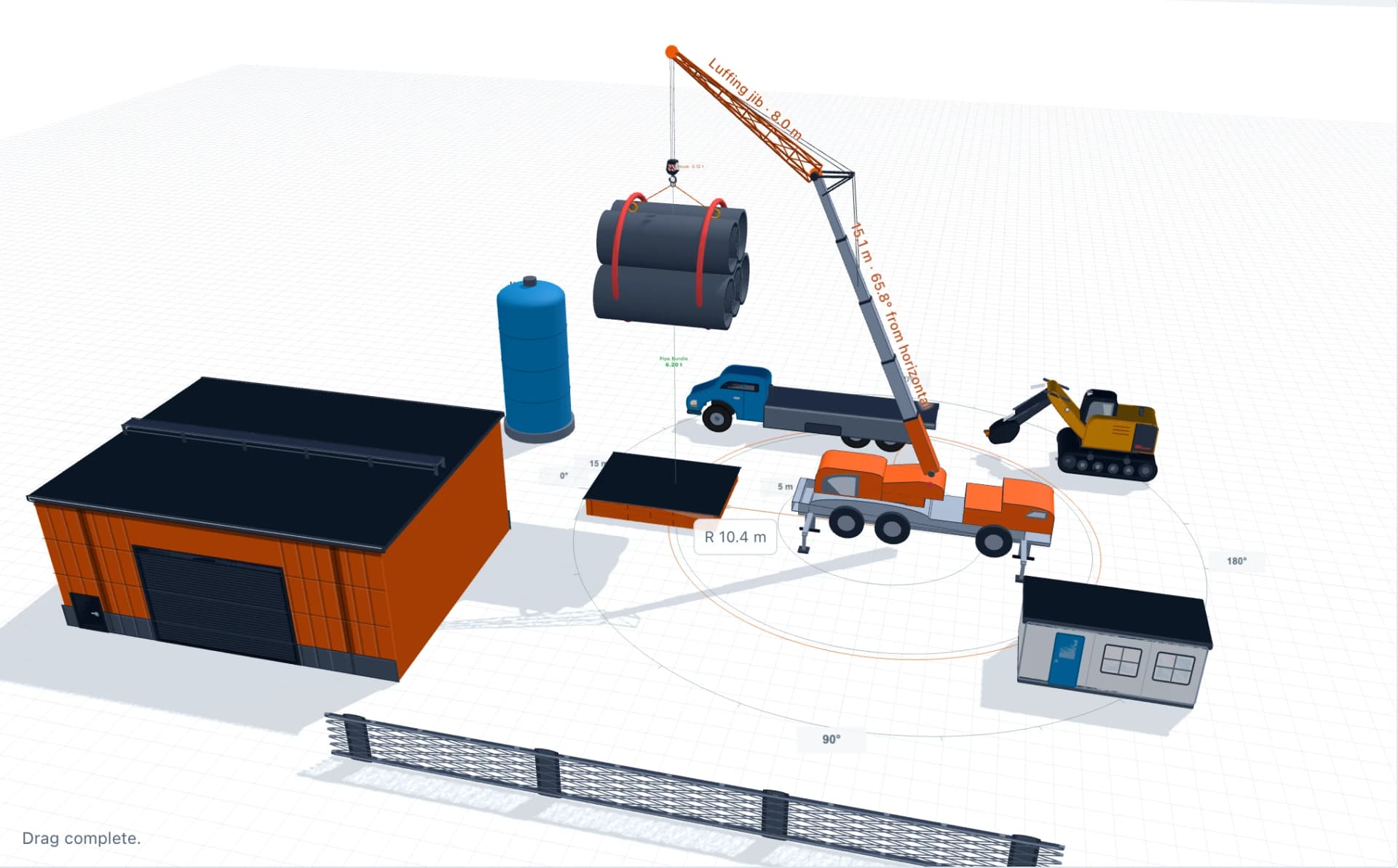
See the whole lift in 3D Top View.
Check the crane, load and site obstacles together before the crane arrives, alongside the range chart and lift plan.
See 3D Top ViewThe formula
Area = Outrigger force ÷ Allowable ground pressurekN ÷ kPa gives m². In US units, lb ÷ psf gives ft².
From the area, the size of a square or round mat follows directly:
- Square mat: side = √Area
- Round mat: diameter = √(4 × Area ÷ π)
Worked example — metric
Illustrative numbers: a verified maximum outrigger load of 350 kN and an allowable ground pressure of 200 kPa from the geotechnical report for that position.
- Minimum area — 350 ÷ 200 = 1.75 m².
- Square mat — √1.75 = 1.32 m per side.
- Round mat — √(4 × 1.75 ÷ π) = 1.49 m diameter.
- Round up and recheck — Mats come in set sizes. A 1.4 × 1.4 m mat (1.96 m²) gives 350 ÷ 1.96 = 178.6 kPa — 89.3% of the allowable value, with little margin. A 1.5 × 1.5 m mat (2.25 m²) gives 155.6 kPa, or 77.8%.
Worked example — imperial
Illustrative numbers: a maximum outrigger load of 80 kips (80,000 lb) and an allowable ground pressure of 4,000 psf.
- Minimum area — 80,000 lb ÷ 4,000 psf = 20 ft².
- Square mat — √20 = 4.47 ft per side — about 4 ft 6 in once rounded up.
- The same in metric — 80 kips is 355.9 kN and 4,000 psf is 191.5 kPa; 355.9 ÷ 191.5 = 1.86 m².
Unit conversions
| Quantity | Conversion |
|---|---|
| Force | 1 kip = 1,000 lb force = 4.448 kN |
| Force | 1 tonne-force = 9.80665 kN |
| Force | 1 US short ton (2,000 lb) = 8.896 kN |
| Pressure | 1 kPa = 1 kN/m² |
| Pressure | 1 t/m² = 9.80665 kPa |
| Pressure | 1 psf = 0.04788 kPa; 1 ksf = 47.88 kPa |
| Pressure | 1 psi = 6.895 kPa |
| Area | 1 ft² = 0.0929 m² |
Does the whole mat bear?
The area formula assumes the mat spreads the outrigger load evenly over its whole area. That is only true if the mat is stiff enough for the size of the outrigger float sitting on it.
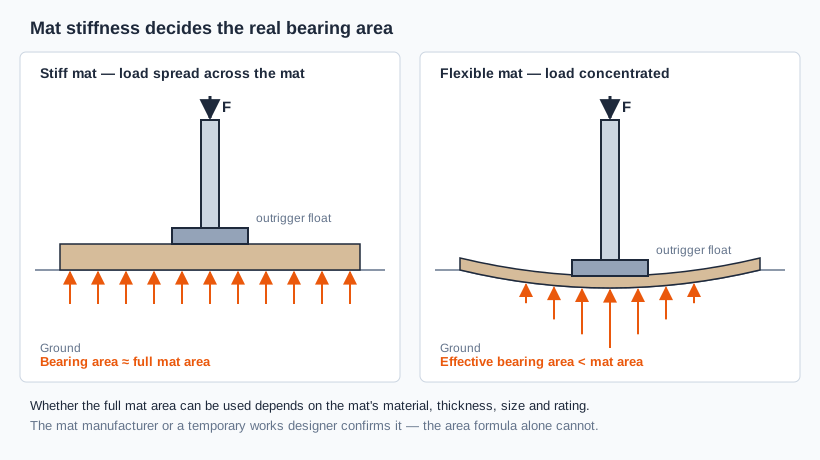
A thin or flexible mat under a small float behaves more like a slightly larger pad than a full-size mat. Whether the full area can be counted depends on the mat’s material, thickness and size, and on the float size. The mat manufacturer’s rating, or a temporary works designer, has to confirm it.
Choosing and placing a mat
- Use a mat rated by its manufacturer for the outrigger load and float size.
- Check its condition: cracked, rotten, warped or damaged mats do not spread load as rated.
- Place it on level, prepared ground with full contact — no voids or high spots underneath.
- Centre the float on the mat.
- Do not stack mats or improvise packing unless the arrangement has been designed.
- Keep mats back from excavations, trenches and slopes unless a designer has checked the edge.
What this calculation does not cover
- The mat’s own strength in bending, shear and punching.
- Load spread through layered mats or granular platforms.
- Voids, buried services, backfilled trenches and nearby excavations.
- Settlement over time, and an out-of-level set-up as the ground moves.
The calculation gives a minimum contact area. It does not design the mat or approve the ground.
Common questions
How big should a crane outrigger pad be?
Big enough that the maximum outrigger load divided by the pad area stays below the allowable ground pressure for that position, with margin. For example, 350 kN on ground with a 200 kPa allowable needs at least 1.75 m² — a square pad of about 1.32 m.
Does doubling the mat area halve the ground pressure?
Only if the mat is stiff enough to spread the load over its whole area. A flexible mat under a small float concentrates pressure near the centre, so a bigger but thinner mat may help less than its area suggests.
What are standard crane mat sizes?
Sizes vary by manufacturer and material. Start from the minimum area you need, choose a rated mat at or above it, and recheck the pressure using the mat’s real size.
Can I use timber crane mats?
Yes, if they are rated for the load and in good condition. Timber, steel and composite mats differ in stiffness and capacity, so use the rating for the specific mat.
Run the numbers
Turn a verified maximum outrigger reaction and ground capacity into a minimum contact-area suggestion.