

Crane Ground Bearing Pressure, Explained
Ground bearing pressure is the load an outrigger or track puts into the ground divided by the area carrying it. The check compares two numbers: the pressure the crane will apply, and the pressure the ground can accept. They come from completely different places — one from the crane, one from the ground — and confusing them is the most common error in this calculation.
Updated 28 October 2026
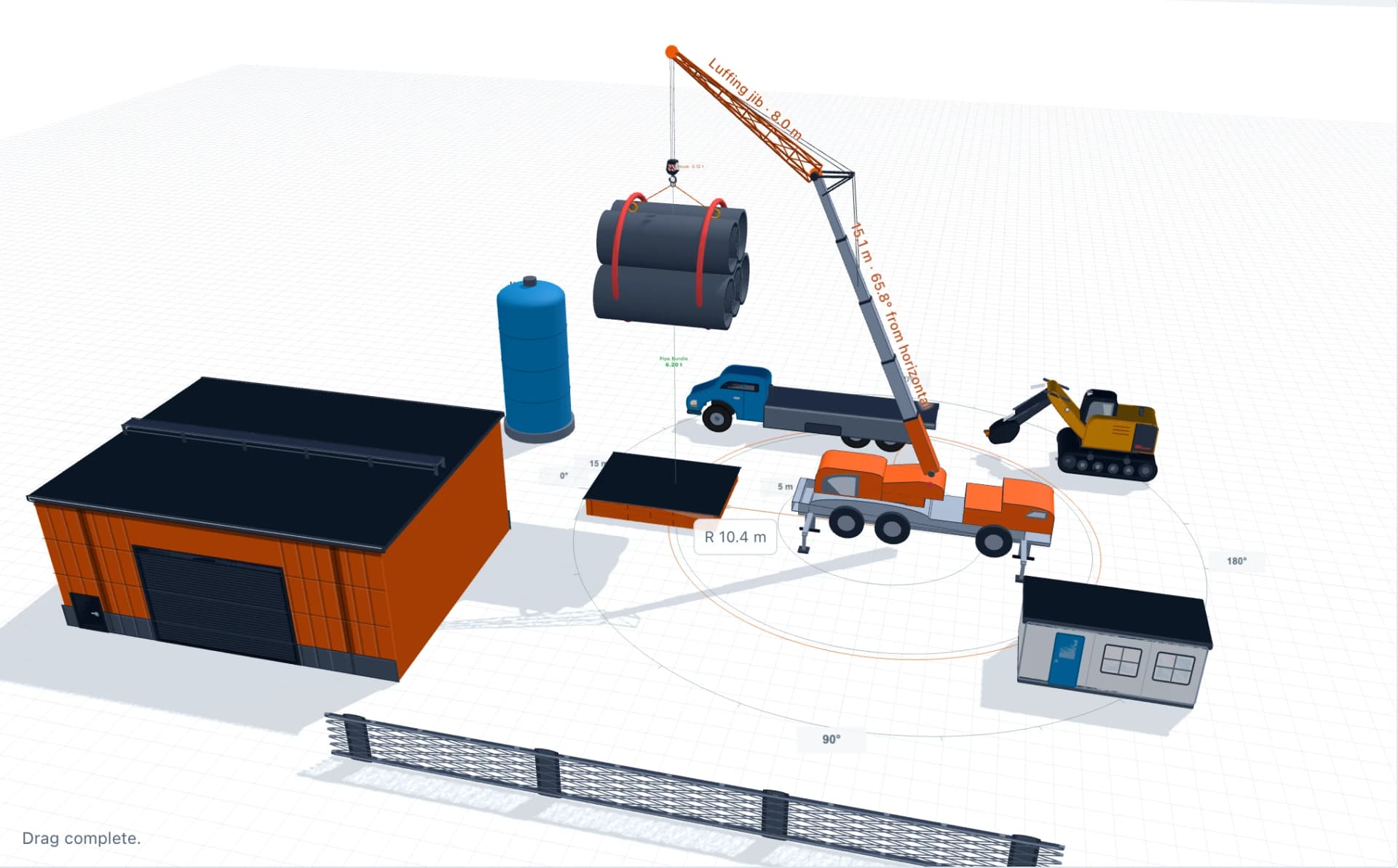
See the whole lift in 3D Top View.
Check the crane, load and site obstacles together before the crane arrives, alongside the range chart and lift plan.
See 3D Top ViewThe formula
Pressure = Outrigger force ÷ Bearing areaForce in kilonewtons and area in square metres gives kilopascals directly, because 1 kN/m² = 1 kPa.
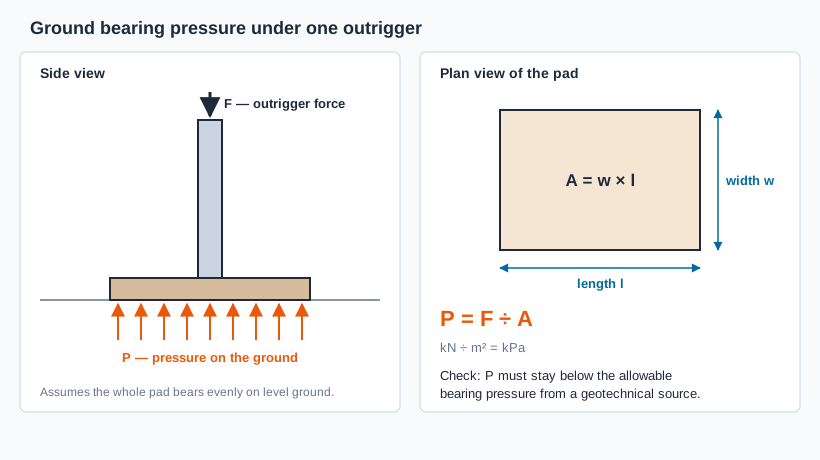
The arithmetic is trivial. Everything that makes this calculation hard sits in the two inputs: knowing the real force on the individual outrigger, and knowing what the ground under that outrigger can actually take.
Getting the units right
Load charts and geotechnical reports rarely use the same units, and converting in your head is where errors creep in.
- 1 tonne-force = 9.80665 kN, so a 25 t leg load is about 245 kN.
- 1 kN/m² = 1 kPa exactly.
- 1 t/m² = 9.80665 kPa, so 10 t/m² is roughly 98 kPa.
- In US units: 1 kip (1,000 lb force) = 4.448 kN, 1 psf = 0.04788 kPa and 1 ksf = 47.88 kPa, so 1,000 psf is about 47.9 kPa.
- A pad quoted in millimetres has to be converted before it becomes an area in square metres: a 1200 × 1200 mm pad is 1.44 m², not 1 440 000.
Where the allowable value comes from
The crane side of the check comes from the manufacturer’s data. The ground side does not come from the crane at all. It comes from investigating the ground where the outrigger will stand: a geotechnical report, a site investigation, or a field test such as a plate load test, where a steel plate is loaded on the ground and its settlement is measured.
Interpreting that result into an allowable bearing pressure is a geotechnical judgement. It is not something to estimate from the look of the ground, and a value from one part of a site does not carry over to another part a few metres away.
Worked example
The numbers below are illustrative, chosen to show the method. They are not taken from any particular crane or site. Use your own verified reaction and your own allowable value.
- Take the maximum single-leg reaction — Suppose the manufacturer’s outrigger load data gives a maximum single-leg reaction of 25 t for this lift. In kilonewtons that is 25 × 9.80665 = 245.17 kN.
- Work out the bearing area — The pad is 1200 × 1200 mm. Converted to metres that is 1.2 × 1.2 = 1.44 m².
- Divide force by area — 245.17 kN ÷ 1.44 m² = 170.25 kPa, which is the same as 17.36 t/m² or about 3,556 psf.
- Compare with the allowable value — Suppose the geotechnical report for that position gives an allowable bearing pressure of 150 kPa. 170.25 ÷ 150 = 113.5% of the allowable. The pad on its own is too small.
- Size the bearing area you actually need — Rearrange the formula: area = force ÷ allowable pressure = 245.17 ÷ 150 = 1.63 m². For a square mat that is a side of about 1.28 m.
Checking three pad sizes against that 150 kPa allowable shows why the margin matters, not just whether a number is under the line:
- 1.2 × 1.2 m (1.44 m²): 170.3 kPa, 113.5% of allowable — exceeds.
- 1.3 × 1.3 m (1.69 m²): 145.1 kPa, 96.7% of allowable — technically under, but inside the 90% warning band with almost no margin.
- 1.5 × 1.5 m (2.25 m²): 109.0 kPa, 72.6% of allowable — clear margin.
A setup that lands at 97% of the allowable value is one small error in the inputs away from failing. Ground conditions vary, reactions get revised, and pads do not always sit perfectly flat. Treat a result close to the limit as a reason to go larger, not as a pass.
Common mistakes
- Dividing the total weight by four — Outriggers do not share the load equally. Slew position, boom radius, counterweight and outrigger spread shift the load towards the legs nearest the lift. Take a crane and load totalling 60 t: dividing by four suggests 15 t per leg. If the leg nearest the load actually carries 25 t, the real pressure is 67% higher. On a 1.44 m² pad that is the difference between 102 kPa and 170 kPa — against a 150 kPa allowable, one looks comfortable and the other fails. The single-leg reaction has to come from the manufacturer’s data for the exact configuration.
- Getting the pad area wrong by a factor of a million — A 1200 × 1200 mm pad is 1 440 000 mm² but only 1.44 m². Feed the millimetre figure into a formula expecting square metres and the pressure comes out a million times too small — a number so low it looks perfectly safe. Convert to metres before multiplying.
- Assuming the whole pad is bearing — The formula assumes the full face of the pad is carrying load evenly on level ground. A pad that rocks, sits on a high spot, or overhangs an edge is bearing on less area than its dimensions suggest, and the real pressure is higher than the calculation shows.
- Using a value that was not for this spot — An allowable pressure from a textbook table, a previous job, or another part of the same site is not a verified value for where this outrigger stands. The allowable value is only as good as the investigation of that particular ground.
- Checking the surface and ignoring what is under it — A pressure figure says nothing about voids, buried services, backfilled trenches, or nearby excavations. Firm-looking ground over a hidden void can fail at a pressure well below what the surface would suggest.
Crawler cranes
The same idea applies to crawler cranes, with the bearing area being the track contact area rather than a pad. The difference is that pressure under a track is rarely even: it shifts along the track as the crane slews and as the load radius changes. Dividing the total load by the whole track area gives an average, and the peak can be much higher. Use the manufacturer’s track pressure data for the actual lift configuration.
What this calculation does not cover
- How load spreads through a mat, and whether the mat itself can carry it without bending or punching through.
- Voids, buried services, backfill and slopes, none of which show up in a pressure figure.
- Settlement over time, and what happens to the setup as the ground moves.
- Dynamic effects from slewing, wind or an unplanned load pick-up.
A pressure figure is a screening check. It tells you when a setup is obviously not acceptable. It cannot tell you a setup is safe — that decision belongs to a competent person with site-specific ground information.
Common questions
What is a safe ground bearing pressure for a crane?
There is no single safe value. The pressure the ground can accept depends entirely on the ground at that position, and it has to be established by a competent geotechnical source for that site. The crane determines the pressure applied; only the ground investigation can tell you what is acceptable.
Is there a chart of ground bearing pressure values I can use?
Tables of typical values by soil type exist, but they are general guidance, not a value for your site. Two sites described with the same soil name can behave very differently, and conditions change with moisture, fill and what lies beneath. Use a typical value to sanity-check a report, never in place of one.
Can I just divide the crane weight by four?
No. Outrigger loads are not shared equally. Slew position, boom radius, counterweight and outrigger spread can put a large share of the total on one leg, so the maximum single-leg reaction must come from the manufacturer’s data for the exact configuration.
Does a bigger mat always fix a ground bearing pressure problem?
A larger bearing area lowers the calculated pressure, but only if the mat spreads the load across its whole area. A mat that bends under the outrigger concentrates load near the centre, and a mat can punch through or crack. The mat itself has to be rated for the load, which this calculation does not check.
Run the numbers
Check required ground pressure and the minimum bearing area for one explicitly supplied outrigger reaction.