

Crane Outrigger Loads, Explained
An outrigger load — or outrigger reaction — is the force one outrigger pushes into its pad and the ground below. It is the number that drives ground bearing pressure and mat size. It is also the number most often guessed, because it changes every time the crane slews or the load moves out, and the only reliable source is the manufacturer’s data for the exact setup.
Updated 28 October 2026
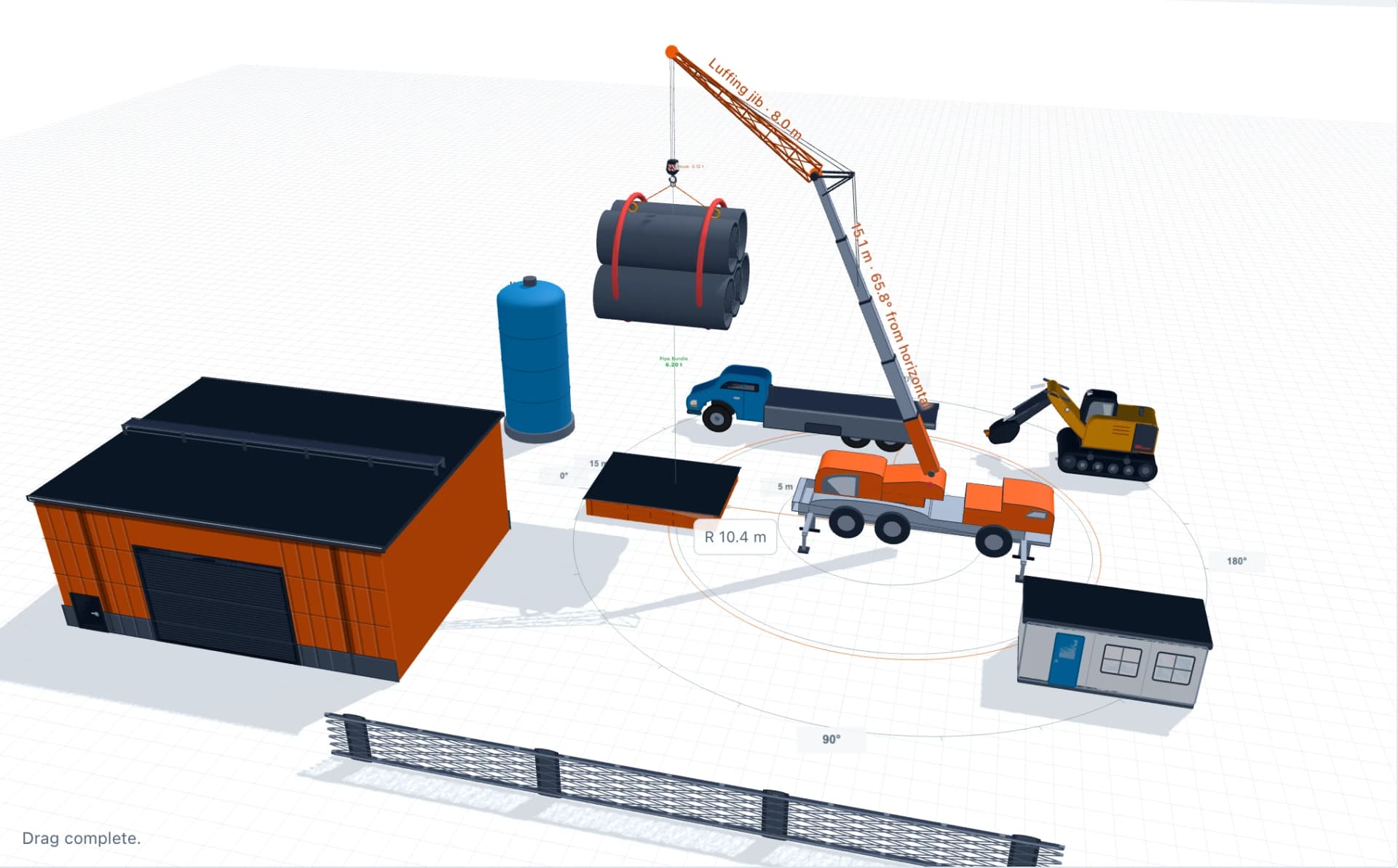
See the whole lift in 3D Top View.
Check the crane, load and site obstacles together before the crane arrives, alongside the range chart and lift plan.
See 3D Top ViewWhat an outrigger reaction is
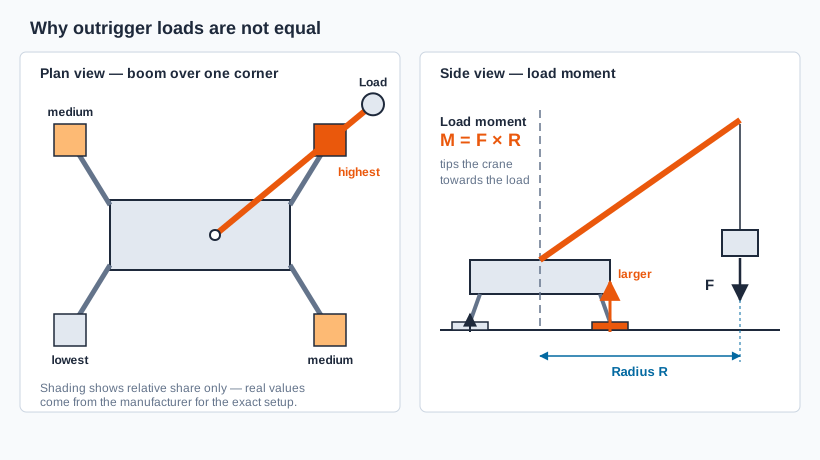
On outriggers, the whole crane — carrier, superstructure, counterweight, boom, hook block, rigging and load — is carried by the outrigger pads. For a static lift, the outrigger reactions add up to that total weight. What they do not do is share it equally.
The load moment
Load moment = Lifted load force × RadiusThe lifted load includes the load, rigging and hook block. Kilonewtons × metres gives kilonewton-metres (kN·m).
Load moment is the part of the outrigger calculation that needs no crane data. It grows in direct proportion to radius: the same load at 30 m puts 50% more moment on the crane than at 20 m.
- Lifted mass — A 10,000 kg load with 1,000 kg of rigging and hook block is lifted at a 20 m radius. These numbers are illustrative.
- Convert to force — 11,000 kg × 9.80665 ÷ 1,000 = 107.873 kN.
- Multiply by radius — 107.873 kN × 20 m = 2,157.5 kN·m.
- Move the load out — At 30 m the same load gives 107.873 × 30 = 3,236.2 kN·m.
Why “total weight ÷ 4” is unsafe
Dividing the total weight by four gives an average, not the maximum. Take an illustrative crane and load totalling 60 t: the average is 15 t per leg. If the manufacturer’s data shows the leg nearest the load carrying 25 t, the real load on that leg is 67% higher than the average — and every ground pressure and mat size based on 15 t is wrong by the same margin.
Where a verified outrigger load comes from
- The manufacturer’s outrigger or pad load data for the crane, in its operator documentation or supplied by the manufacturer.
- Manufacturer planning software. For example, Manitowoc publishes a ground bearing pressure estimator for its lattice-boom cranes and an outrigger pad load calculator for Grove cranes, and Liebherr’s Crane Planner 2.0 reports ground bearing pressures and ground forces.
- A calculation by a competent engineer using the full crane data: self-weight and centre of gravity, counterweight, outrigger geometry, boom configuration and the lift itself.
Whichever source you use, the inputs must match the lift: the same counterweight, outrigger spread, boom length, radius, slew range and load.
What changes the outrigger load
- Load, rigging and hook block weight.
- Radius — the further out, the larger the load moment.
- Slew angle relative to the outriggers.
- Counterweight configuration.
- Outrigger extension: full, intermediate or retracted.
- Boom length and any jib or attachments.
- Ground that is not level, wind on the boom and load, and dynamic effects from slewing, starting and stopping.
From outrigger load to ground pressure
Once you have the verified maximum single-leg load, the ground check is simple: divide it by the bearing area and compare the result with the allowable ground pressure for that position. The ground bearing pressure and crane mat sizing guides walk through both steps.
Ground pressure = Maximum outrigger load ÷ Bearing area1 tonne-force = 9.80665 kN, and kN ÷ m² = kPa.
Common questions
How do I calculate outrigger loads for a mobile crane?
The load moment (lifted load × radius) can be calculated from the lift alone, but the load on each outrigger also depends on the crane’s self-weight, centre of gravity, counterweight and outrigger geometry. Use the manufacturer’s outrigger load data or software for the exact configuration, or a competent engineer’s calculation.
Can I divide the crane weight by four?
No. That gives the average leg load. The leg nearest the load can carry much more, and the ground and mats must be checked against the maximum.
When is an outrigger most heavily loaded?
Often when the boom is over or near that outrigger at the largest radius of the lift, but it depends on the crane and its configuration. The manufacturer’s data shows where the maximum occurs.
Why doesn’t the free outrigger calculator give a per-leg value?
Because a reliable per-leg figure needs crane data the calculator does not have — self-weight, centre of gravity, counterweight and outrigger geometry. The calculator works out the load moment and geometry, and leaves the per-leg reaction to the manufacturer or a competent engineer rather than guessing it.
Run the numbers
Calculate load moment and geometry without inventing unsafe per-leg reactions from incomplete crane data.