

Sling Angle and Sling Leg Tension, Explained
When a load hangs from two or more slings at an angle, each leg carries more than its share of the weight. Part of the pull in each leg holds the load up; the rest pulls the legs towards each other and does no lifting at all. The shallower the angle, the bigger that sideways share — and the higher the tension in every leg, shackle and lifting point.
Updated 28 October 2026
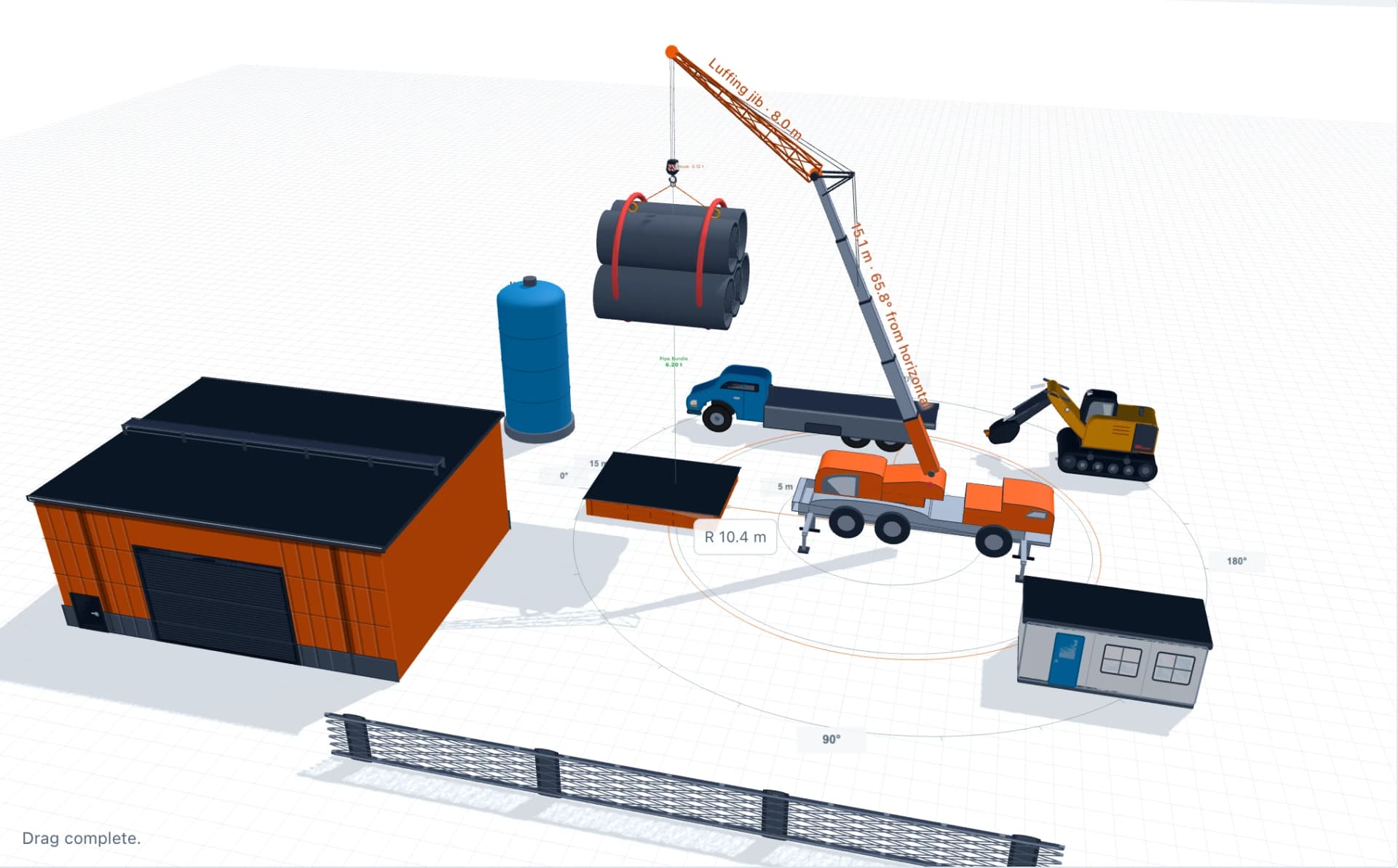
See the whole lift in 3D Top View.
Check the crane, load and site obstacles together before the crane arrives, alongside the range chart and lift plan.
See 3D Top ViewThe formula
Leg tension = Load ÷ (Load-bearing legs × sin θ)θ is the sling angle measured from the horizontal. If your angle is measured from the vertical, use cos instead of sin.
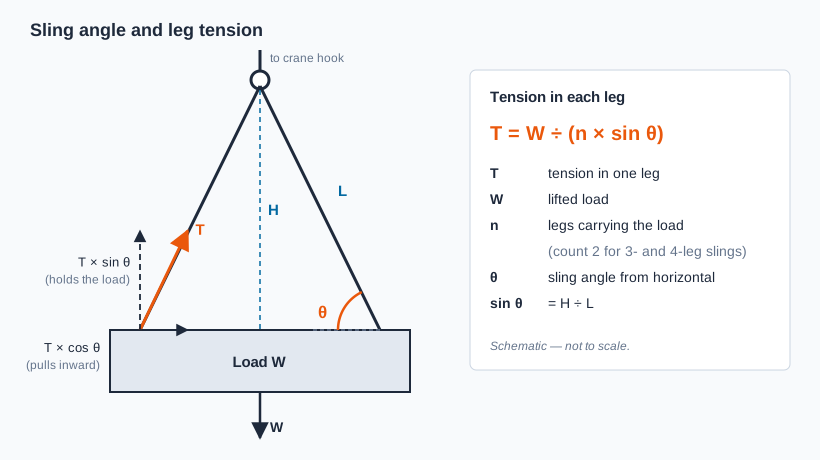
At 90° — legs hanging straight down — each leg carries exactly its share of the load. As the angle drops, sin θ gets smaller, so the tension needed to hold the same load rises.
Measuring the sling angle
sin θ = Height ÷ Leg lengthHeight is measured vertically from the lifting point up to the hook or master link. Leg length is the length of the same leg between those two points.
Measure the rigging as it will actually hang, not as it was drawn. A shorter sling, or lifting points further apart, both lower the angle and raise the tension.
Sling angle factor table
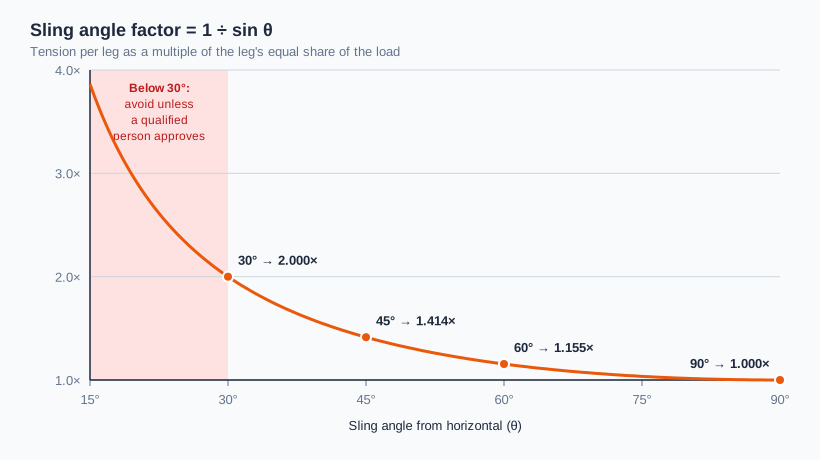
The sling angle factor is 1 ÷ sin θ. Multiply each leg’s equal share of the load by this factor to get the leg tension. The right-hand column applies it to a 10,000 kg load on a two-leg sling.
| Angle from horizontal | Angle factor (1 ÷ sin θ) | Tension per leg — 10,000 kg on 2 legs |
|---|---|---|
| 90° | 1.000 | 5,000 kg |
| 75° | 1.035 | 5,176 kg |
| 60° | 1.155 | 5,774 kg |
| 50° | 1.305 | 6,527 kg |
| 45° | 1.414 | 7,071 kg |
| 40° | 1.556 | 7,779 kg |
| 30° | 2.000 | 10,000 kg |
| 20° (avoid) | 2.924 | 14,619 kg |
Worked example: two-leg bridle
The numbers below are illustrative. Use your own load weight, rigging dimensions and the WLL marked on your slings.
- Lifted mass — An 8,000 kg load is lifted on a two-leg bridle. The lifting points are 3.6 m apart, so each is 1.8 m horizontally from the hook.
- Find the angle — With 3.0 m legs, the height from lifting point to hook is √(3.0² − 1.8²) = 2.4 m. sin θ = 2.4 ÷ 3.0 = 0.800, so θ = 53.1°.
- Calculate the tension — Leg tension = 8,000 ÷ (2 × 0.800) = 5,000 kg, which is 49.0 kN.
- Compare with the WLL — If each leg is rated at 6,000 kg in this configuration, each leg is at 5,000 ÷ 6,000 = 83.3% of its WLL.
- See what shorter legs do — Swap to 2.2 m legs on the same lifting points. The height becomes √(2.2² − 1.8²) = 1.26 m, sin θ = 0.575 and θ = 35.1°. Tension rises to 8,000 ÷ (2 × 0.575) = 6,957 kg — 116% of the 6,000 kg WLL. The same load on shorter slings is now overloaded.
Longer slings, or a spreader beam that keeps the legs closer to vertical, bring the tension back down.
Three- and four-leg slings: count two legs
It is tempting to divide the load by four for a four-leg sling. In practice, small differences in leg length, hardware and the stiffness of the load mean a rigid load often ends up hanging on two diagonally opposite legs, with the other two barely loaded.
Common rigging practice is therefore to check three- and four-leg slings as if only two legs carry the load, unless a competent person has confirmed that the legs share it — for example through an equalising arrangement. The OutriggerPlan sling calculator applies the same rule.
Take the same 8,000 kg load on four legs at 60°. Dividing by four gives 8,000 ÷ (4 × 0.866) = 2,309 kg per leg. Counting two legs gives 8,000 ÷ (2 × 0.866) = 4,619 kg per leg — twice as much. Slings chosen on the four-leg figure could be carrying double the load they were selected for.
Why shallow angles are avoided
ASME B30.9, the US standard for slings, and sling manufacturers advise against horizontal sling angles below 30° unless the sling manufacturer or a qualified person approves. At 30°, each leg of a two-leg sling already carries the full weight of the load.
The sideways pull grows too. On a 10,000 kg load with two legs at 30°, each leg carries 10,000 kg of tension, and about 8,660 kg of that pulls sideways on the lifting point. Lifting lugs and eyes designed for a vertical pull may not be rated for that.
- Use longer slings to raise the angle.
- Use a spreader beam or lifting beam so the legs hang closer to vertical.
- Move the lifting points closer together only if the load is designed to be lifted that way.
What this calculation does not cover
- An off-centre centre of gravity, which loads the legs unequally.
- Reductions for hitch type (choker or basket), D/d ratio, sharp edges and sling material.
- Shock loading and dynamic effects from starting, stopping or swinging the load.
- The rating of shackles, master links, hooks and lifting points, each of which needs its own check.
- The condition of the sling — inspect it before every use.
A leg-tension figure is a screening check. A competent person decides whether the rigging is suitable.
Common questions
What is the sling angle factor?
It is 1 ÷ sin θ, where θ is the sling angle from horizontal. It tells you how much higher the tension in each leg is than the leg’s equal share of the load: 1.155 at 60°, 1.414 at 45° and 2.000 at 30°.
What is the minimum safe sling angle?
ASME B30.9 and sling manufacturers advise against horizontal sling angles below 30° unless the sling manufacturer or a qualified person approves. Higher angles keep tension lower: at 60° the angle factor is only 1.155.
How do I calculate the load on a 4-leg sling?
Unless a competent person has confirmed that all four legs share the load, check it as if only two legs carry it: tension = load ÷ (2 × sin θ). Dividing by four can underestimate the real leg load by half.
Should the sling angle be measured from horizontal or vertical?
The formula on this page uses the angle from horizontal. Many sling tags and rating tables use the angle from vertical instead. Convert by subtracting from 90°: 60° from vertical is 30° from horizontal.
Run the numbers
See how lower sling angles increase tension and compare a conservative effective-leg result with the entered per-leg WLL.